I was scanning my shelves for a book to review when the wrong one caught my eye.
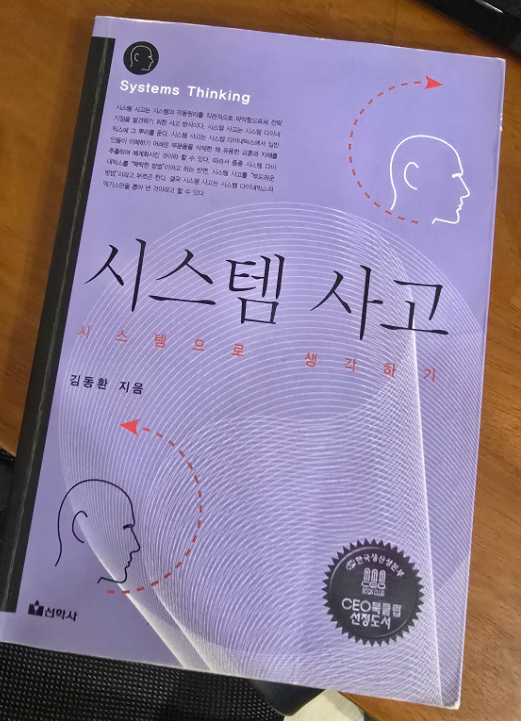
“Systems Thinking.” I grabbed it on the strength of the title alone, then opened it to find org management and self-help: nothing to do with Bertalanffy. The most gloriously idiotic off-target book I bought back when I was digging into systems theory. So much for the review. The sight of it dragged me back to that time instead, and this is that story.
Back in my undergrad days, I stumbled on the phrase “systems theory.”
A rationalist forever chasing logical completeness, I naturally assumed it was about design. That’s the impression the word “system” gives: how you stack a large program together with good structure. And it had “General” in front of it, no less. Something beyond any one language or domain, an ultimate design principle: I felt some kind of mastery would land in my hands once I’d read it.
As it happened, I was devouring Scott Meyers’ More Effective C++ at the time. A cursed manual that sends you into qi-deviation. The kind of book that, once you finish it, drops you into design hell where your actual work can’t advance a single step. I had learned every tiny trap of pointers, destructors, and exception safety, so writing even one line felt like crossing a minefield. Naturally I couldn’t let a keyword like “General System Theory” slide by.
But finding a book that actually explained it, at a level I could enter, was harder than expected. The first ones I picked up were all abstract and stiff, with nowhere to get a foothold. I combed the university library stacks and spent days wandering the bookshops of Sinchon, hunting for one volume a beginner could read.
And when I finally cracked open the book I had tracked down, what came out was biology.
Cells, organisms, metabolism. Open systems instead of design patterns; flow equilibrium instead of architecture. I was surprised.
Life is not matter but organization
General System Theory was the work of Ludwig von Bertalanffy, an Austrian biologist. His starting point was a revolt against reductionism, the reflex of the science of his day. Reductionism holds that to understand life you break it into small parts and examine the pieces.
He said no. What makes something alive is not a special substance but the way the parts are arranged: their organization. Don’t go hunting for a vital force. Aliveness lives not in the parts but in the relations among them.
A few core ideas, in plain terms.
First, a living thing is an open system. Matter and energy pass through it constantly. Most of the atoms that make up your body get replaced over the years. And yet “you” persist. The substance flows through while the form remains: Bertalanffy called this flow equilibrium, also known as dynamic equilibrium. Think of a candle flame or a whirlpool in a river: the shape holds steady while the material composing it changes every instant.
Second, equifinality. An open system can reach the same final state from different starting points and along different paths. A closed physical system is pinned down by its initial conditions; a living system is not. Jostle a developing embryo and it still grows into the same adult.
Third, hierarchy. Living things stack in layers. Cells gather into tissues, tissues into organs, organs into an organism, organisms into an ecosystem. Each layer is made of the layer below, yet takes on properties the lower layer never had.
Fourth, emergence. That “new property” just mentioned is emergence. The whole is more than the sum of its parts, and “aliveness” resides precisely in that organized whole.
And here is the striking part: the same principles recur at every one of these layers: cell, organism, ecosystem, even society. That is why it is “general.” It was a theory not of any particular creature but of living systems as such.
No design mastery, but still
So systems theory was not a story about software architecture. My mistake.
But its bedrock claim is, in hindsight, exactly the thing a person thirsty for logical completeness should have pricked up their ears at. If life is not matter but organization, if it is a question of arrangement rather than any specific material, then in principle you can build life out of anything able to hold that arrangement.
Not carbon required. Even numbers on a grid would do.
I didn’t grasp that implication at the time. The thing that would show it to me, right before my eyes, I met only much later.
Half a century on, Lenia
It begins with Conway’s Game of Life (1970). Cells on a grid switch on and off, and a few simple rules give rise to moving patterns like the glider. It is, plainly, blocky, digital-looking life.
That is the Game of Life above: press ▶ to let the generations run, and click the canvas to bring cells to life. You can watch gliders crawl out of just a few lines of rules.
Lenia takes one step further. Released by Bert Chan around 2018, it makes everything about the Game of Life continuous. A cell’s value is no longer 0 or 1 but anything in between, and space, time, and rule are all smooth.
The result is astonishing. Instead of the angular glider, an organically shaped “creature” appears. The most famous, Orbium, glides smoothly across the screen like a microorganism under a microscope, or a jellyfish.
Above is the official WebGL demo by Bert Chan, Lenia’s creator (source: Lenia). You can load various species and run them in real time. There is only one rule: each cell looks at its neighbors and nudges its value up or down a little. And yet a creature rises on top of it, holding its own shape as it glides. Poke it and it mostly returns to form. That habit of settling back to the same shape after you disturb it is exactly what we saw earlier.
These creatures keep their shape while moving, wobble and recover when nudged, and come in a whole zoo of species. No one designed them cell by cell. They arise from the rule on their own and persist as self-sustaining patterns.
Bertalanffy’s definition, on a computer
Watching a Lenia creature crawl, I am watching Bertalanffy’s definition run.
Flow equilibrium. The creature holds its form even though every cell value is overwritten each frame. The material (numbers) flows past while only the pattern remains. A whirlpool made of computation.
Equifinality. Perturb it and it self-repairs to its original shape. Start from a different initial blob and it converges to the same creature. Same destination, many paths.
Hierarchy. A single cell is dead. Cells woven together become a creature, and creatures in turn collide and push against one another, forming relations. Layers rise out of one flat rule.
Emergence. The “creature” is nowhere in particular. There is no living cell. The organized pattern itself is the animal.
And crucially, there is no chemistry here, no carbon, not a scrap of biology. Only organization. If you strip away every material substrate and the thing still crawls, still sutures itself back together, still holds its own body, then Bertalanffy was right. Aliveness lies in the arrangement, not the stuff. Because Lenia keeps nothing but the pattern, it proves his claim in its most extreme form.
The most beautiful evidence for a theory that refused the machine
Here is the twist.
Bertalanffy built General System Theory in part as resistance to mechanism: a refusal to reduce life to a machine. In spirit it was a humanist gesture: life is more than a mechanism.
And yet the most beautiful demonstration of his idea turns out to be a machine. A deterministic automaton running on a computer.
What would he have made of Lenia? Would he have welcomed it as a triumph of his self-organization, or waved it off: “that’s just another mechanism imitating life”? A founder failing to recognize his own heir is not rare in the history of ideas. (Chomsky waved off chatbots as structureless calculators, yet that very machine, which learns language only when the right structure is built in first, is exactly what proves his own core claim: that something must be in place before learning can begin.)
Chris Langton called artificial life “life as it could be.” Not only life as we know it, but every form life could take. The whole field, in truth, inherited Bertalanffy’s wager: that life is organization unbound from any medium. Lenia is that wager paying out on a screen.
Pressing the definition from both ends
We watched Lenia pass the claim that organization is enough for life. So now it is time to press that claim from both ends. At one end the question is: is copying the organization really enough to bring life along? At the other end: is the definition so loose that anything at all counts as alive?
One end: C. elegans
The first end is a real creature. If Lenia builds organization up out of nothing, there is an experiment running the other way: copying the organization of a real creature wholesale and porting it into a computer.
The stage for that is C. elegans, a roundworm one millimeter long with exactly 302 neurons. It is the only animal whose wiring diagram, its connectome, has been mapped in full. Which neuron connects to which is drawn out completely. We hold the organism’s entire blueprint of organization.
If Bertalanffy is right, reproducing that organization should bring the worm’s life along with it. The OpenWorm project attempts exactly this: an open-source effort to stand up the connectome, the muscles, and the body in software, and to revive a living, wriggling worm from the wiring alone.
OpenWorm’s C. elegans crawling simulation: wriggling reconstructed in software, starting from the wiring diagram.
And yet the worm has not fully woken up. The diagram is all there, and it is not enough. You also need when and how strongly each neuron fires, how the body bends in water, the timing and the physics, before the wriggle appears. Even if being alive lives in organization, “organization” turned out to mean more than a wiring diagram.
C. elegans is Lenia’s mirror image. Lenia got something life-like out of pure structure with no material; C. elegans, trying to port the structure of real life, is learning that the structure runs far deeper than a wiring diagram. Organization was not too little; the word “organization” was bigger than it looked.
The other end: a star
Now the other end. What if the problem is not that organization is too little, but that it is too common? Look at a star. Astonishingly, a star passes several of Bertalanffy’s conditions. Held in the balance of gravity pulling in and radiation pressure pushing out, it keeps its form for billions of years (flow equilibrium), dumps entropy out as light, and even has feedback: squeeze the core and it burns hotter, and it swells and cools. With no chemistry and no carbon, a star already looks fairly alive.
Yet scaling up does not make things more alive. Lifelikeness peaks at the galaxy and falls off on either side. A planetary system is richer in structure but is a clockwork bound by gravity, and so it is dead; the cosmic web is the height of hierarchy but a one-way street collapsing under gravity and dispersing with expansion, and so it is dead too. The peak is the galaxy. It draws in gas and shapes it into stars, blows those stars apart in supernovae to scatter heavy elements, and conceives the next stars from the ash. The shape endures while the material is endlessly cycled; it regulates its own rate of star formation and remakes its own parts. There is a reason astronomers call it a “galactic ecosystem.”
What separated peak from valley was not size, nor the height of the hierarchy. Does matter flow through while the form remains, and does it regulate itself and remake its own parts? Those two, and only those. The galaxy beats the planetary system because it is a flame, not a clockwork. So the definition is not broken but sharpened. Aliveness lies in organization, but that organization must be not a static structure but one that cycles matter and holds itself together. It is the same reason Lenia looked alive: the numbers churn while the pattern stays.
Life is not intelligence
Here is a common misconception worth clearing up. We tend to assume that life comes with intelligence attached. But the two are separate axes. Life appeared on Earth 3.8 billion years ago; nervous systems, only 600 million. For most of that long stretch, and for most of the biomass filling the Earth right now, life gets by without a single neuron. Bacteria, trees, fungi are alive but do not think. Intelligence is not the essence of life but a late, rare offshoot.
Bertalanffy’s definition has no intelligence in it either. An open system, flow equilibrium, an arrangement that maintains itself: the conditions for being alive make no room for problem-solving. Orbium growing and healing its wounds is not being clever, and C. elegans with its 302 neurons is far from what we would call intelligence. Lifelikeness and mind were different words from the start.
Artificial life, meeting artificial intelligence
Even though life and intelligence are separate like this, lately the two meet on the same stage: the place where artificial life meets artificial intelligence.
On one side, neural networks are made to learn the rules of an automaton. Instead of a human setting the rules by hand, the network learns for itself the rule to grow and to repair damage. Like a lizard’s tail, a pattern that regrows into its own shape after being cut away is produced by learning.
On the other side, AI searches universes like Lenia in our place. Creatures like Orbium were originally found by hand, but now large AI models recognize “lifelike” patterns and automatically discover new creatures. Machines go hunting for Orbium’s descendants.
And there is a deeper question. Rather than designing intelligence, could we let it grow like life? This is the current that treats open-ended evolution, endlessly generating novelty, as a condition of intelligence. Intelligence not as a finished blueprint but as a process that keeps surpassing itself.
Back where I started
On a personal note, it is also a story that came full circle. To that rationalist who went looking for design mastery and, disappointed, met biology instead, half a century of ideas flowed on and the biology came back as computation. My youthful mistake (“surely systems theory must be about design”) was not wrong. It was merely early.
Life was a design problem after all. Just not the design I had been looking for in a C++ book.
Sources · Further reading
- Lenia and Orbium: Bert Wang-Chak Chan, “Lenia: Biology of Artificial Life”. Project page, paper arXiv:1812.05433, expanded arXiv:2005.03742. The demo embedded above is Chan’s official WebGL implementation (source and creature data).
- Run it yourself in the browser: Lenia WebGL demo · beginner-friendly From Conway to Lenia tutorial.
- Ludwig von Bertalanffy, General System Theory (1968).
- C. elegans connectome and simulation: the OpenWorm project. The complete 302-neuron wiring diagram was first laid out in White et al., “The Structure of the Nervous System of the Nematode Caenorhabditis elegans” (Phil. Trans. R. Soc. B, 1986).
- Neural cellular automata that grow and self-repair: Mordvintsev et al., “Growing Neural Cellular Automata” (Distill, 2020).
- Searching for artificial life with AI: Kumar et al. (Sakana AI), “Automating the Search for Artificial Life Using Foundation Models” (arXiv:2412.17799). See also Particle Lenia (Google).