The Midnight Snack Dilemma
You’re on a diet. The smell of fried chicken fills the air. Two voices speak up simultaneously:
- Voice A: “Eating now means exceeding today’s calorie limit. Stay strong.”
- Voice B: “It smells so good… just one piece…”
Sound familiar? Psychologists Pacini and Epstein argue this isn’t random: it’s the result of two independent information processing systems running in parallel inside your brain.
Two Systems: “The Thinker” vs “The Feeler”
graph LR
    subgraph Rational System
        A[Conscious] --> B[Slow]
        B --> C[Step-by-step reasoning]
        C --> D[Verbally explainable]
    end
    subgraph Experiential System
        E[Preconscious] --> F[Fast]
        F --> G[Intuitive judgment]
        G --> H[Hard to explain]
    end
“The Thinker” (Rational System)
| Feature | In brief | Example |
|---|---|---|
| Conscious | Aware of thinking | “Wait, let me calculate this” |
| Slow | Takes time | Comparing prices for the best deal |
| Sequential | Step-by-step | “A implies B, B implies C” |
| Explainable | Can justify | “This product is better because…” |
“The Feeler” (Experiential System)
| Feature | In brief | Example |
|---|---|---|
| Preconscious | Unaware of why | “I just feel uneasy” |
| Fast | Nearly instant | Judging someone’s first impression |
| Holistic | Grasps the whole | “This place has a nice vibe” |
| Hard to explain | “Just a feeling…” | “I can’t explain why, but this feels right” |
Key insight: These two systems are independent. Being strong in one doesn’t mean being weak in the other. A person can be high in both, or low in both.
The Jellybean Experiment: When Intuition Beats Logic
The researchers gave 144 participants a simple choice:
- Small tray: 10 jellybeans, 1 red → Win probability 10%
- Large tray: 100 jellybeans, 9 red → Win probability 9%
Pick a red jellybean = win money!
Logically, the small tray (10%) is the better bet. But the large tray looks like it has more red jellybeans. The results?
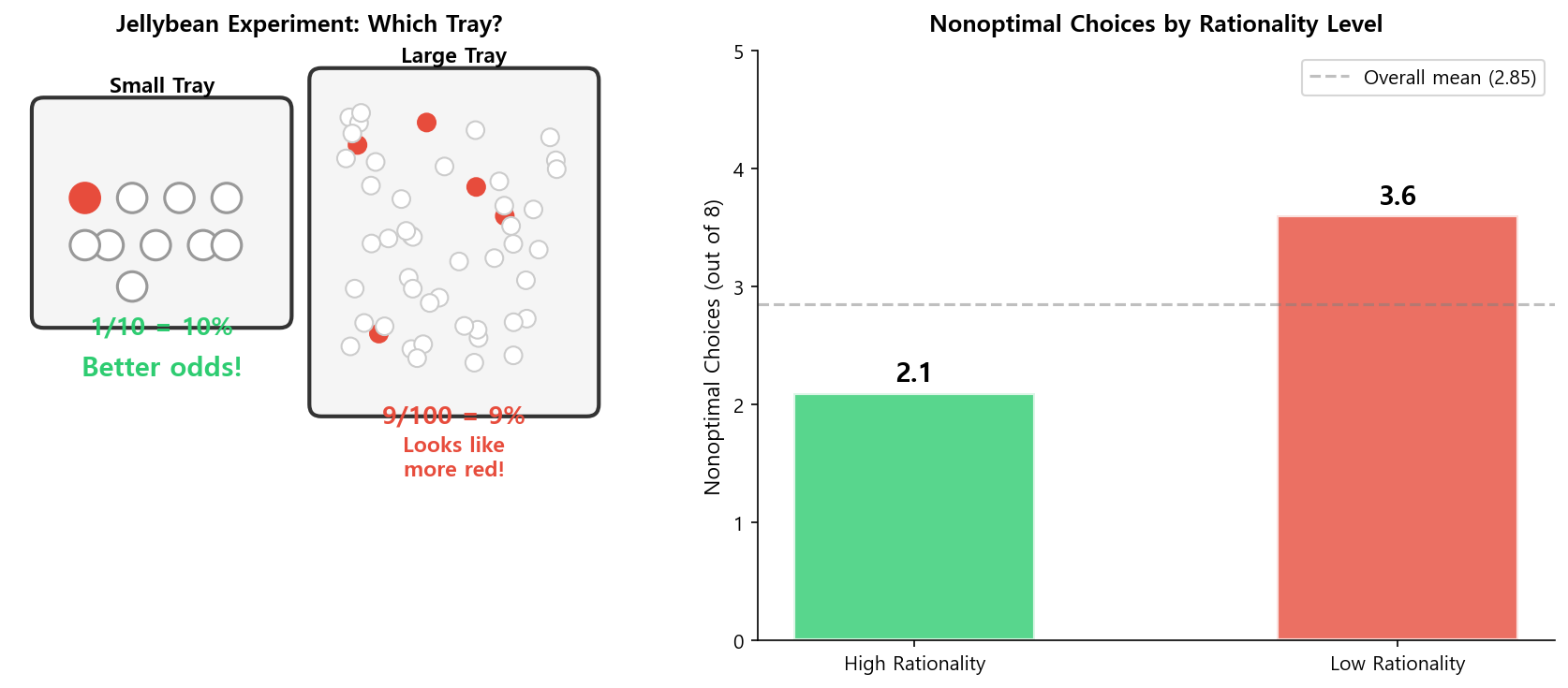
- A full 84% of people made at least one suboptimal choice
- High-rationality participants averaged 2.1 suboptimal choices (vs 3.6 for low-rationality)
- When stakes increased, people high in experientiality but low in rationality made even more suboptimal choices
“The Feeler” gets more excited as stakes rise: “The one with more red!” “The Thinker,” when strong enough, pumps the brakes: “Hold on, let’s check the math.”
Personality Profiles of Each Thinking Style
What are people with strong rational vs. experiential systems like? A survey of 399 participants revealed:
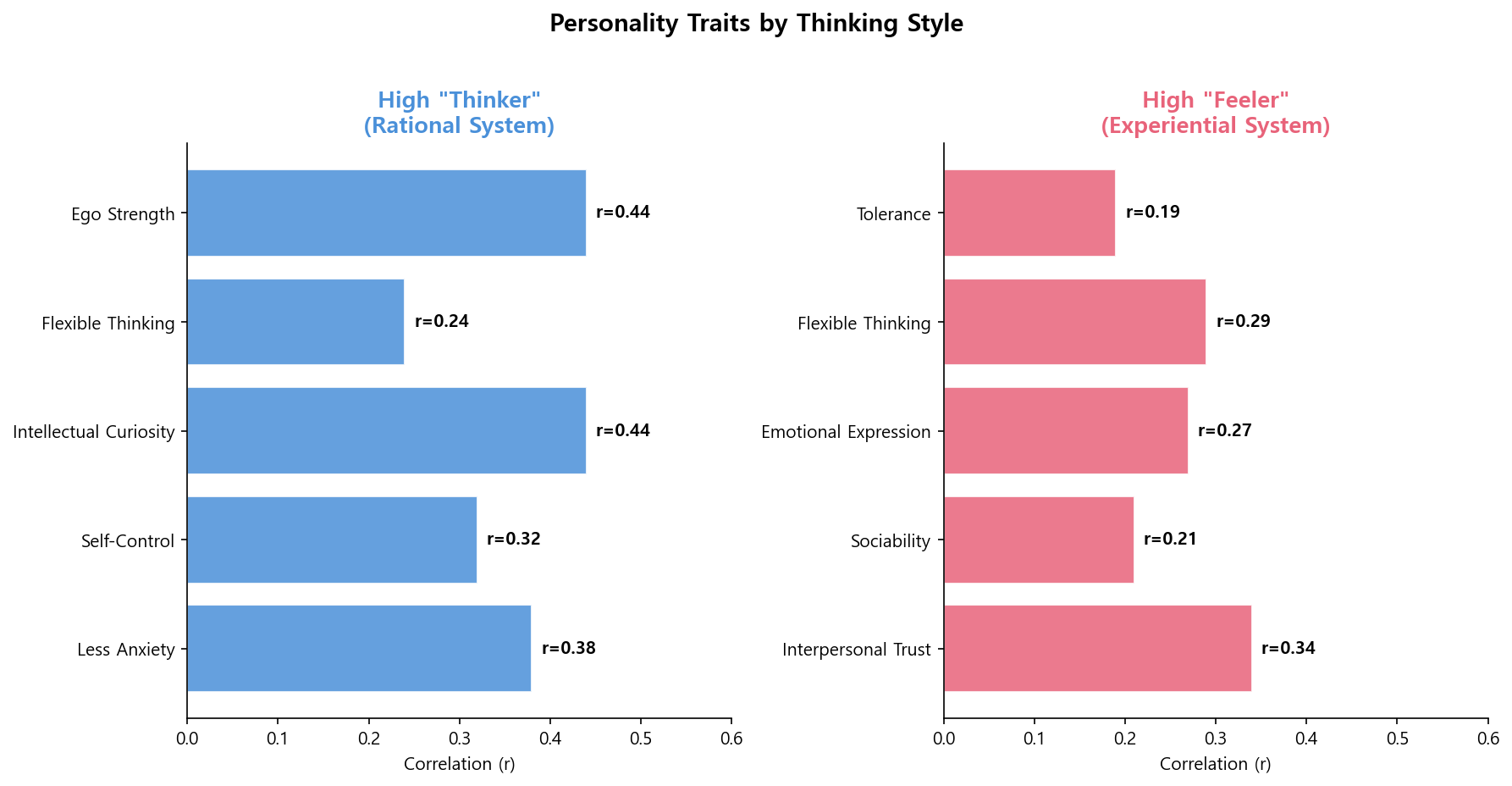
High “Thinker” Profile
- Less anxiety and depression (not swayed by emotions)
- Higher self-control (does what needs to be done)
- Greater intellectual curiosity (loves learning new things)
- Less dogmatic (doesn’t insist “I’m always right”)
High “Feeler” Profile
- Better interpersonal trust (trusts people, builds relationships)
- More sociable (enjoys meeting people)
- More emotionally expressive (shows joy when happy, sorrow when sad)
- Less black-and-white thinking (more flexible)
How REI Differs from Standard Personality Tests
Can the Big Five personality traits (Openness, Conscientiousness, Extraversion, Agreeableness, Neuroticism) explain what REI measures?
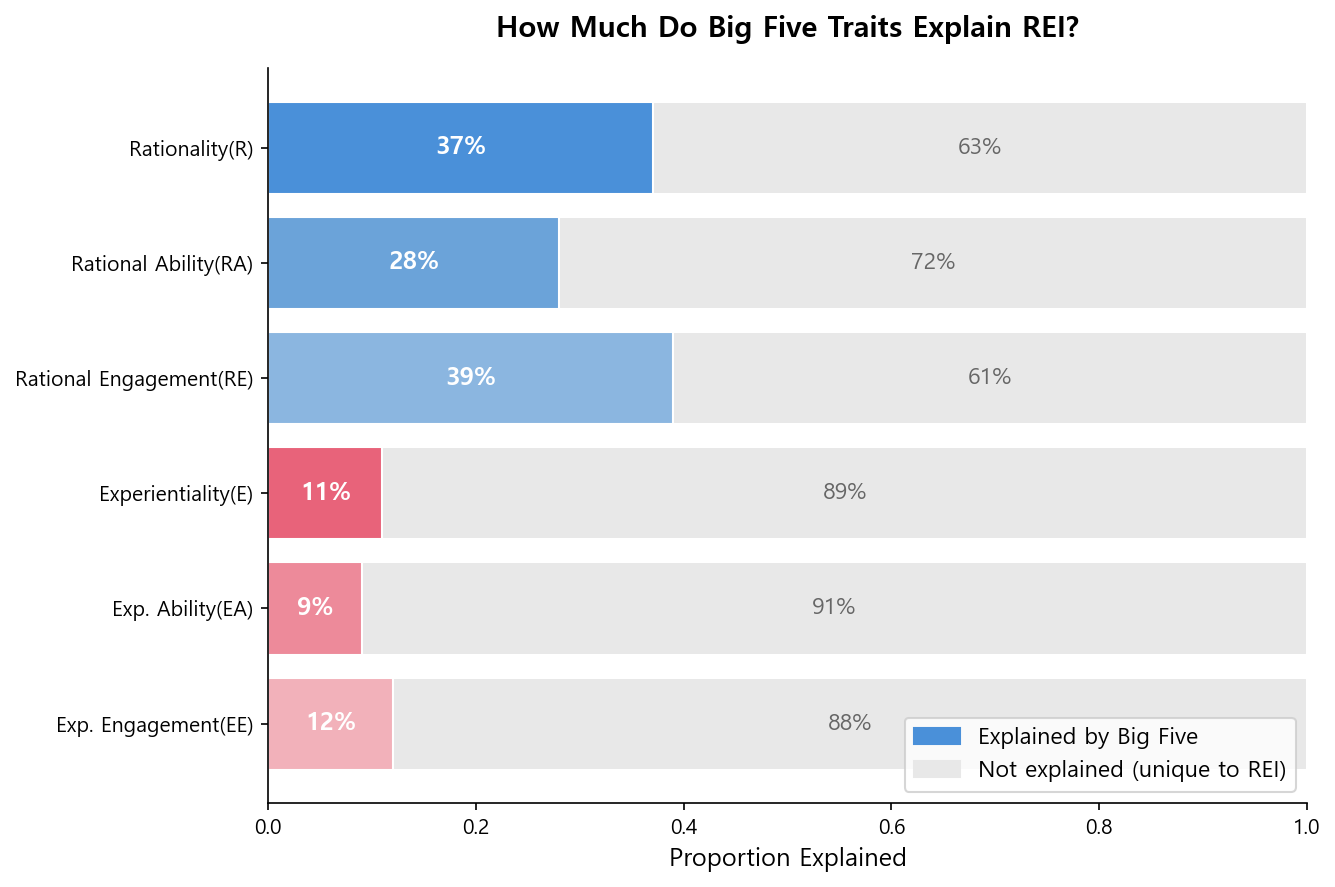
- Rationality: 63–72% of variance is not explained by Big Five
- Experientiality: 88–91% of variance is not explained by Big Five
The “thinking style” measured by REI captures a unique dimension that traditional personality tests miss.
The 6 Scales of REI-40
The REI-40 measures each system along two dimensions (ability and engagement):
- RA (Rational Ability): Self-assessed analytical competence
- RE (Rational Engagement): Enjoyment of cognitive effort
- EA (Experiential Ability): Self-assessed intuitive competence
- EE (Experiential Engagement): Reliance on intuition/feelings
- R (Rationality): Overall rational processing = RA + RE
- E (Experientiality): Overall intuitive processing = EA + EE
Gender Differences
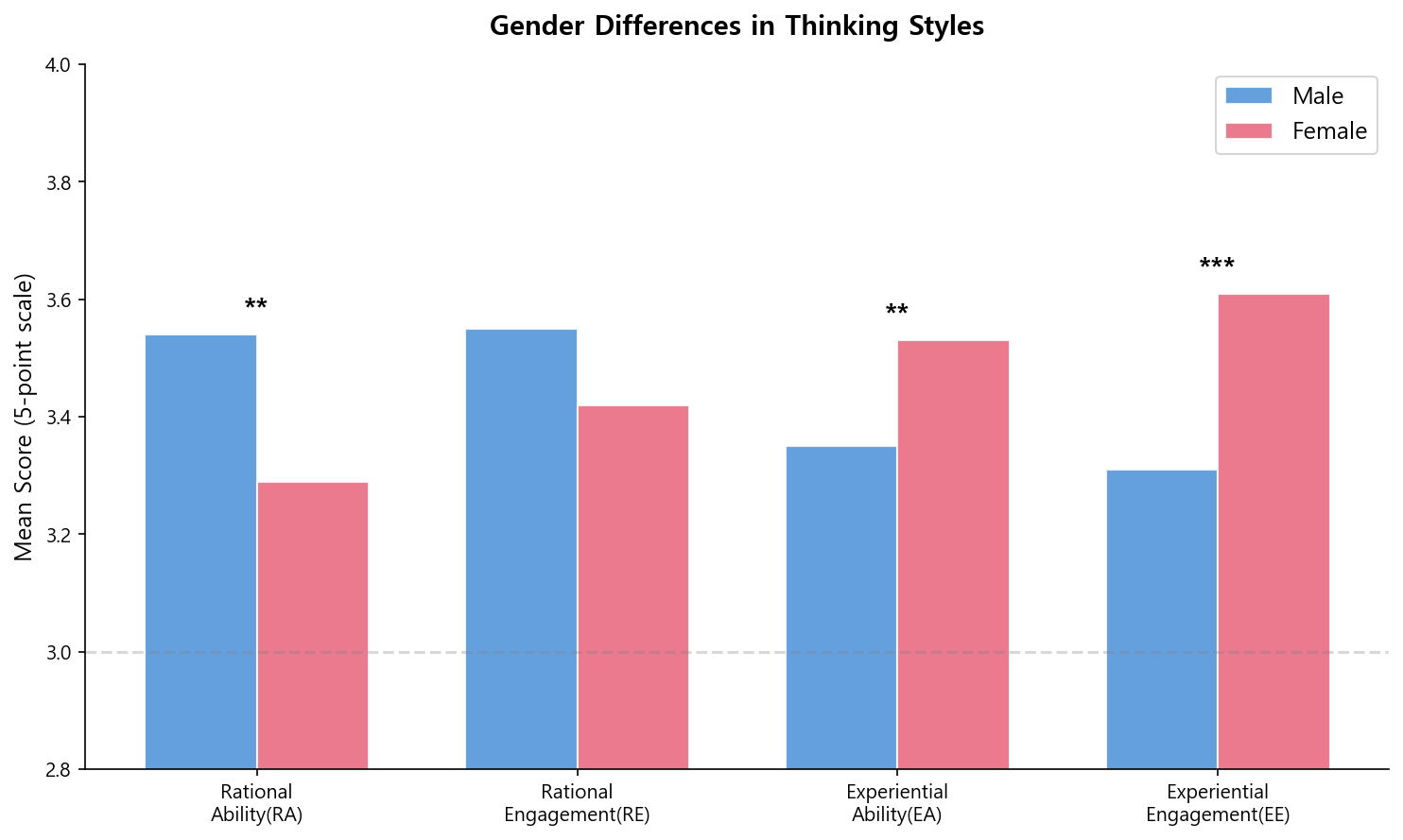
- Men: Rate themselves higher in rational ability
- Women: Rate themselves higher in experiential ability and engagement
- But no gender difference in “enjoying thinking” (rational engagement)
Caveat: These are self-reports, so social expectations may play a role.
Key Correlation: Independence Confirmed
The correlation between the two main scales:
| REI Scale | Rationality | Rat. Ability | Rat. Engagement | Experientiality |
|---|---|---|---|---|
| Rationality | 1.00 | |||
| Rat. Ability | .91 | 1.00 | ||
| Rat. Engagement | .92 | .68 | 1.00 | |
| Experientiality | -.04 | -.06 | -.02 | 1.00 |
The correlation between Rationality and Experientiality: r = -.04 (essentially zero). Strong evidence that the two systems are truly independent.
Ability vs. Engagement: Being Good at It vs. Enjoying It
REI measures each system on two subdimensions: “ability” (how good you are) and “engagement” (how much you enjoy it).
| Type | Example |
|---|---|
| High ability + High engagement | Good at math and loves it |
| High ability + Low engagement | Good at math but hates it |
| Low ability + High engagement | Struggles with math but finds it fun |
| Low ability + Low engagement | Bad at math and doesn’t care |
Interesting finding: People who enjoy a processing style (high engagement) are more flexible and tolerant than those who are merely good at it.
Does Strong Intuition Mean Biased Thinking?
Many assume “relying on gut feeling = bias.” The data shows the opposite:
People with strong intuition were actually more flexible and tolerant.
Intuition isn’t “biased thinking”: it’s “a different way of thinking.”
Real-Life Implications
graph TD
    A[Situation arises] --> B["The Thinker" evaluates]
    A --> C["The Feeler" evaluates]
    B --> D{Agreement?}
    C --> D
    D -->|Yes| E[Quick decision]
    D -->|No| F[Deliberation & compromise]
    F --> G[Final behavior]
Everyone has both systems. You can be high in both or low in both.
Each excels at different things.
- Logic → emotional regulation, self-control
- Intuition → relationships, empathy, flexible thinking
Logic serves as the brake. When intuition pulls you the wrong way (especially with high stakes), logic says “Wait.”
Most behavior is a compromise. Purely logical or purely intuitive actions are rare.
Try It Yourself: REI-40
Take the REI-40 right here. Answer all 40 items honestly and your scores will be calculated automatically.
1 = Definitely not true / 2 = Not true / 3 = Neutral / 4 = True / 5 = Definitely true
Your REI Profile
Norm Comparison (N=399 college students)
Limitations
- College students only: Results may not generalize to other ages or cultures
- Self-report measures: People who say “I’m logical” may not actually be
- Experiential structure: The ability/engagement distinction wasn’t as clean for the experiential scale
Related: LLM Experiment
Curious how LLMs score on the REI-40? We tested 5 frontier models: see the full results in Do LLMs Have Thinking Styles? REI-40 Experiment on 5 Frontier Models.
Reference
Pacini, R., & Epstein, S. (1999). The relation of rational and experiential information processing styles to personality, basic beliefs, and the ratio-bias phenomenon. Journal of Personality and Social Psychology, 76(6), 972-987.